Bailey Bingham
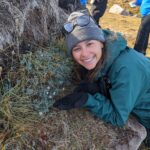
Bayley is a global change ecologist and science educator, originally from Ontario. For her PhD with Team Shrub, she is investigating how heat waves, extended growing seasons, and permafrost thaw interact to influence tundra plant growth and phenology on Qikiqtaruk – Herschel Island in the Yukon Arctic using growth chamber experiments, time-lapse photography and long-term phenology data. She completed my MSc in Biology at the University of Guelph in 2021, where she focused on science education and built a love for sharing research beyond academia. This passion for science outreach brought her to Nunavut, as a lecturer and hiking guide, where she fell in love with the landscapes and communities of Arctic Canada. Bayley enjoys working across disciplines and with different communities to better understand how ecosystems are changing.
Research Project: The impact of summer Arctic heat waves on tundra vegetation
The Arctic is warming up to four times faster than the global average, and summer heat waves are becoming more common. These short periods of unusually hot weather can strongly influence tundra plants. Although gradual warming is known to shift Arctic vegetation composition, phenology and biodiversity, we know far less about how sudden heat waves impact tundra ecosystems and how these impacts might vary across the highly heterogenous environmental conditions of the Arctic. Understanding both the direct effects of heat waves and the degree to which microclimate buffers or amplifies them is essential for assessing the resilience of tundra plant communities.
My project asks: How do summer Arctic heat waves affect tundra vegetation? Specifically, I will investigate how heat waves impact tundra vegetation phenology, growth, and community composition across scales and how how these effects vary across microclimates and spatial patterns in the landscape. To answer these questions, I will integrate fieldwork, controlled experiments, and long-term monitoring. I will use vegetation surveys, temperature and humidity sensors, and time-lapse photography to track plant growth, seasonal timing and fine-scale environmental variation in the field. In parallel, I will run controlled experiments with intact vegetation samples in their original soil in climate-controlled growth chambers, manipulating heat wave intensity, duration, and timing. Finally, I will also analyze long-term datasets from Qikiqtaruk–Herschel Island and the International Tundra Experiment (ITEX) network to identify patterns of
phenological shifts and growth responses associated with warmer summers across decades.
By combining these approaches, I will provide a comprehensive, multi-scale understanding of how Arctic heat waves shape tundra plant communities and their resilience. This work aligns with the broader goals of the Resilience Project by exploring how spatial patterns, microclimates, and disturbance dynamics influence whether Arctic ecosystems withstand or undergo change. It will help improve predictive models of ecosystem responses and support decision-making for northern communities on the frontline of climate change.