Myriam Cloutier
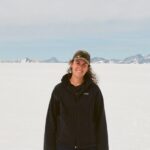
Myriam joined the Resilience project as a PhD student in Team Shrub in January 2025 at the University of British Columbia in Vancouver, Canada. She has a background in biology and ecology, and has been working with remote sensing for the past 5 years. She completed an MSc at Université de Montréal, in Québec, Canada, where She combined different disciplines to determine how the changing seasons might influence the performance of a neural network to identify tree species from drone imagery. She’s always been curious about the different ecosystems around Canada and is now shifting her research from temperate forest to the Arctic tundra, looking at permafrost and plants using drones and satellites. This will allow her to further expand my remote sensing knowledge and experience and will give her the opportunity to visit the northern Yukon.
Research project: Influence of permafrost degradation on warming tundra landscapes and
Permafrost thaw is increasing across the Arctic due to rising global temperatures, causing soil erosion, altering hydrology and shifting carbon cycles. These changes threaten ecosystem resilience, wildlife habitats, infrastructure and the livelihood of northern communities. Understanding the processes driving permafrost thaw at landscape scale is critical, particularly given the high spatial heterogeneity created by thaw-related features.
My research will focus on assessing current remote sensing methods being used to monitor patterns of permafrost degradations. I will then evaluate temporal changes in permafrost degradation across northern Yukon. I will also work on determining how permafrost thaw impacts tundra plants across the landscape, in particular their phenological patterns.
To do so, I will travel to the Canadian Arctic, specifically on Qikiqtaruk – Herschel Island and the Yukon North Slope, to acquire multispectral drone imagery and field surveys over the next years. I will combine these data with decades-long time-series of vegetation surveys, permafrost data and imagery to detect changes over the landscape. By mapping changes through time, I will be able to determine a pattern in the trajectory of permafrost degradation. This spatial analysis will also be compared with phenological data to quantify the effects of permafrost thaw on tundra vegetation. Preliminary analysis of the drone imagery shows increase of ice-wedge degradation and shrubification in wetter areas of the landscapes, indicating subtle changes can be detected through high-resolution imagery within a decade.