
Dynamics of coexistence states
Spatial boundaries between coexistence states, such as in the savanna-savanna woodland case, by themselves do not generate the richness of spatial patterns necessary for the multi-stability by which tipping may be evaded. However, similar to homogeneous states that may be destabilized by Turing bifurcations causing Turing patterns, spatial fronts between coexistence states typically also bifurcate, deform or destabilize and may thus be the origin of a multitude of evolving localized spatial patterns (Hagberg and Meron 1994a, Hagberg and Meron 1994b). Moreover, the coexistence states themselves may also destabilize, which gives rise to the coexistence of patterned and non-patterned states and fronts between those (Doelman et al 2004, Sandstede and Scheel 2001) (Fig. 1C, Fig. 5).

Figure 5. Coexistence states of patterned vegetation (gap pattern) and non-patterned bare state and spatial boundary between them in Australia (Google Earth). Surface area approximately 200×200 m. Note the individual trees with shadow for resolution and scale.
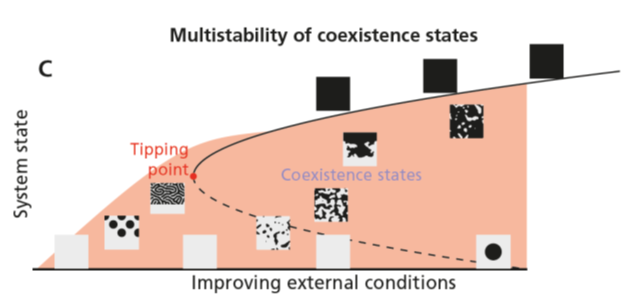
Figure 1C. Multi-stability of coexistence states. Evasion of tipping can also be due to multi-stability of coexistence states. Following disturbance (e.g. grazing, fire), the spatial system allows for mosaics of alternative stable states in space, known as coexistence states, thereby evading tipping of the complete, wide-ranging ecosystem. These spatial patterns originate in the region of alternative stable states before the tipping point; the evolving spatial patterns can also persist beyond the tipping point with worsening environmental conditions, thereby constituting an alternative pathway evading tipping points (Rietkerk et al 2021).
Several of these mechanisms have been observed in ecological models (Contento and Mimura 2020, Jaїbi et al. 2020, Zelnik and Meron 2018). In fact, it has been shown numerically that front instability can reverse desertification by growing vegetation fingers backward into the degraded state (Fernandez-Oto et al 2019). The patterns generated by evolving coexistence states will subsequently provide ecosystems with various gradual routes they may follow to evade tipping under changing environmental conditions. We will generalize the concept of Busse balloons for these cases, and develop a general mathematical theory by which these dynamics can traced and predicted. Once again the singular perturbed nature of the ecosystem models is expected to enable the fundamental understanding of the underlying mechanisms (van Heijster at al 2010, van Heijster and Sandstede 2014, Jaïbi et al 2020). For instance, we will establish conditions for which an invading front that leaves a homogeneous stable state behind triggers a counter-invasion of an alternative patterned state. Moreover, we expect to device ways by which degradation induced by front propagation may be evaded by local manipulations at the front zone that trigger counter-propagating recovery fronts.