
Impact of the rate of change and noise
So far, RESILIENCE mostly focused on the impact of spatial patterns on bifurcation-induced tipping, however, we expect that spatial processes will have a very similar potential impact on noise-induced tipping and rate-induced tipping. In fact, it is unproductive to try to distinguish between these three kinds of tipping in spatial systems (Siteur et al 2014). This is because the paths of resilience through the Busse balloon (Fig. 2B) taken by ecosystems are directly impacted by changes in the rate of change of the driving parameter and in the level of noise. We will study the main mechanism governing the paths of resilience through the Busse balloon, developing a new ‘law of reflection’, as it ‘bounces off’ at the boundary of the Busse balloon (Fig. 2B); this typically happens a number of times during re-patterning and re-re-patterning under changing environmental conditions. In other words, the path of resilience takes the form of a nonlinear ‘game of billiards’ inside a Busse balloon (Fig. 2B, Siteur et al 2014, Bastiaansen et al 2020). During re-patterning and re-re-patterning, there is a subtle relation between the wave lengths of the original destabilizing spatial patterns and those of the emerging stable patterns that strongly depend on the rate of change and the level of noise. Thus, the path of resilience is strongly determined by the dynamics of (modulated) spatial patterns near the boundary of the Busse balloon, which can be studied analytically by the methods of modulation or phase equations (Doelman et al 2009). The research within this project will be based on a direct interaction of detailed and precise simulations and mathematical analysis.
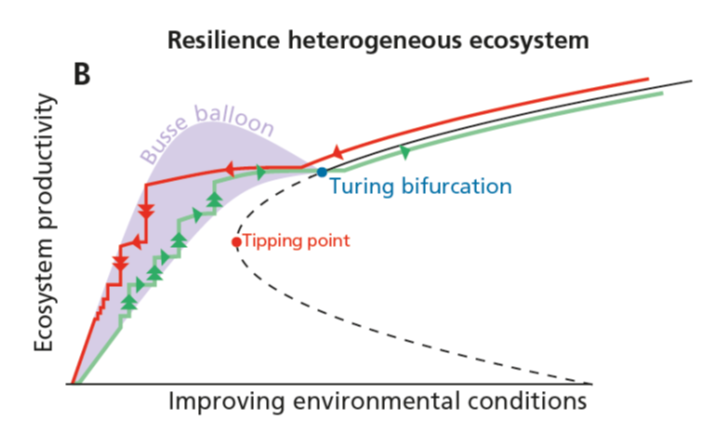
Figure 2B. Pathways of resilience in heterogeneous ecosystem. In multi-stable spatial ecosystems, every set of environmental conditions beyond the Turing bifurcation allows for multiple stable, spatially self-organized states, indicated by the purple area, named the Busse balloon. Here, instead of one critical transition, multiple smaller ecosystem shifts from one spatially patterned state to another occur, which have minor impact on the function or productivity of the ecosystem as a whole, constituting pathways of resilience (Rietkerk et al 2021).